These simple facts can help you save fuel and get more miles out of each tank of gas:
* Have your car tuned regularly. An engine tune-up can improve car fuel economy by an average of 1 mile per gallon.
* Keep your tires properly inflated. Underinflated tires can decrease fuel economy by up to 1 mile per gallon.
* Slow down. The faster you drive, the more gasoline your car uses. Driving at 65 miles per hour rather than 55 miles per hour reduces fuel economy by about 2 miles per gallon.
* Avoid jackrabbit starts. Abrupt starts require about twice as much gasoline as gradual starts.
* Pace your driving. Unnecessary speedups, slowdowns and stops can decrease fuel economy by up to 2 miles per gallon. Stay alert and drive steadily, not erratically. Keep a reasonable, safe distance from the car ahead of you and anticipate traffic conditions.
* Use your air conditioner only when needed. The use of air conditioning can reduce fuel economy by as much as 2 miles per gallon under certain speeds and operating conditions.
* Avoid lengthy engine idling. Turn your engine off when you are delayed for more than a couple of minutes.
* Plan your trips in advance. Combine short trips into one to do all your errands. Avoid traveling during rush hour if possible, to reduce fuel-consumption patterns such as starting and stopping and numerous idling periods. Consider joining a car pool.
For more information and additional materials, please visit API.org.
Thursday, May 01, 2008

THE TRUTH ABOUT OIL AND GASOLINE: AN API PRIMER
America is in a global struggle for energy security and many of us lack a full understanding of the oil and natural gas industry. API has assembled a primer to encourage a constructive public policy debate on meeting the growing energy needs of consumers and industry.
Sections include discussions of global energy demand, price increases, what consumers are paying at the pump, earnings, refinery expansions, the environment and energy security. A full listing of topics included in the primer is included below.
TOPICS INCLUDE:
Future Global Energy Demand
The Myth of “Big Oil”
2006 Largest Oil and Gas Companies
Diesel, Gasoline and Crude Prices
Average Price Increases
Key Factors Affecting Markets
World Oil Consumption
OPEC Surplus Production Capacity
EIA Price Forecast
Commodity Performance
WTI in Dollars and Euros/Yen
What Consumers Are Paying
Earnings of DJIA Companies
Earnings by Industry
Who Owns the Oil Companies?
Stock Repurchases
Income Taxes Paid
Taxes Paid by Oil Vs. Manufacturing Companies
Capital Spending: Where Funds Go
New Investments Increasing
Refinery Capacity Expands
Projected Refining Capacity
Environmental Expenditures
U.S. Crude Oil Resources
U.S. Natural Gas Resources
Energy Efficiency
Future U.S. Energy Demand
Ethanol in Brazil
U.S. Corn Use
Technology Investments
Emerging Energy Investments
Ensuring Our Energy Security
For more information and additional materials, please visit API.org.
Sections include discussions of global energy demand, price increases, what consumers are paying at the pump, earnings, refinery expansions, the environment and energy security. A full listing of topics included in the primer is included below.
TOPICS INCLUDE:
Future Global Energy Demand
The Myth of “Big Oil”
2006 Largest Oil and Gas Companies
Diesel, Gasoline and Crude Prices
Average Price Increases
Key Factors Affecting Markets
World Oil Consumption
OPEC Surplus Production Capacity
EIA Price Forecast
Commodity Performance
WTI in Dollars and Euros/Yen
What Consumers Are Paying
Earnings of DJIA Companies
Earnings by Industry
Who Owns the Oil Companies?
Stock Repurchases
Income Taxes Paid
Taxes Paid by Oil Vs. Manufacturing Companies
Capital Spending: Where Funds Go
New Investments Increasing
Refinery Capacity Expands
Projected Refining Capacity
Environmental Expenditures
U.S. Crude Oil Resources
U.S. Natural Gas Resources
Energy Efficiency
Future U.S. Energy Demand
Ethanol in Brazil
U.S. Corn Use
Technology Investments
Emerging Energy Investments
Ensuring Our Energy Security
For more information and additional materials, please visit API.org.
MapQuest Gas Prices
What's New!
Want to find out what's new on MapQuest Gas Prices? Click here to read all about the new features that are now on the site!
AutoblogGreen
High gas prices got you down? Check AutoblogGreen for the latest news about cars that use less fuel and vehicles that don't use any gas at all.
Want to find out what's new on MapQuest Gas Prices? Click here to read all about the new features that are now on the site!
AutoblogGreen
High gas prices got you down? Check AutoblogGreen for the latest news about cars that use less fuel and vehicles that don't use any gas at all.
Friday, August 04, 2006
more great tips ..
A roof rack or carrier that provides additional cargo space .
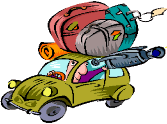
A roof rack or carrier provides additional cargo space and may allow you to meet your needs with a smaller car. However, a loaded roof rack can decrease your fuel economy by 5 percent. Reduce aerodynamic drag and improve your fuel economy by placing items inside the trunk whenever possible.
Avoid carrying unneeded items, especially heavy ones. An extra 100 lbs in the trunk reduces a typical car's fuel economy by 1-2 percent.
Telecommuting or walking .
There are ways that you can get to work that will help you save on gas
consumption for your car.
When driving to work avoid the peak times for rush hours. This way you’ll
use up less fuel and you’ll spend less of you precious time sitting around in
heavy traffic.
Try telecommuting from work if you’re in a position to do so.
If you are the owner of more than one vehicle you should try to drive the car
that has the best gas mileage more often than the one with higher gas
mileage. Save the vehicle with the lower gas mileage for those trips when
you don’t want your new vehicle damaged or don’t want to put the miles on
the odometer.
Find out about ride-sharing programs and carpools that are available in your
local area. By commuting to work with others you’ll be cutting your
monthly fuel costs by as much as half. You’ll also be saving on the wear
and tear of your car. Many large cities have what is known as the HOV lane
(high occupancy vehicle) to encourage drivers to commute to work.
Use the public transit service if it’s convenient for you and available where
you live. You may be able to drive your vehicle to the bus depot and
commute from there. Even though you’re still driving your car part way to
work you’ll still notice a substantial savings when it comes to the cost of
your commute to and from work.
You will definitely save on gas if you leave your car at home. Try walking
to close destinations, or take your bike. Today’s society seems to think that
we need to drive everywhere that go.
If more people walked, rode their bikes, or took public transit there would be
less pollution. As well, you personally will notice a difference in the amount
of money that you spend each month on your gas costs.
consumption for your car.
When driving to work avoid the peak times for rush hours. This way you’ll
use up less fuel and you’ll spend less of you precious time sitting around in
heavy traffic.
Try telecommuting from work if you’re in a position to do so.
If you are the owner of more than one vehicle you should try to drive the car
that has the best gas mileage more often than the one with higher gas
mileage. Save the vehicle with the lower gas mileage for those trips when
you don’t want your new vehicle damaged or don’t want to put the miles on
the odometer.
Find out about ride-sharing programs and carpools that are available in your
local area. By commuting to work with others you’ll be cutting your
monthly fuel costs by as much as half. You’ll also be saving on the wear
and tear of your car. Many large cities have what is known as the HOV lane
(high occupancy vehicle) to encourage drivers to commute to work.
Use the public transit service if it’s convenient for you and available where
you live. You may be able to drive your vehicle to the bus depot and
commute from there. Even though you’re still driving your car part way to
work you’ll still notice a substantial savings when it comes to the cost of
your commute to and from work.
You will definitely save on gas if you leave your car at home. Try walking
to close destinations, or take your bike. Today’s society seems to think that
we need to drive everywhere that go.
If more people walked, rode their bikes, or took public transit there would be
less pollution. As well, you personally will notice a difference in the amount
of money that you spend each month on your gas costs.
Try to combine as many purposes into one trip as you can .
Try to combine as many purposes into one trip as you can for the following
reasons:
• You’ll save time and money by combining the number of errands and
stops that you make in one trip.
• When you make several smaller trips, especially in cold weather, you
will use up to twice as much fuel than if you were taking a
multipurpose trip.
• Cold starts for your car use up more gas and are harder on vehicle
maintenance than driving for a longer period of time, keeping the
engine of your car warm.
• Planning your trip makes your driving more efficient and you spend less
time driving aimlessly from location to location.
reasons:
• You’ll save time and money by combining the number of errands and
stops that you make in one trip.
• When you make several smaller trips, especially in cold weather, you
will use up to twice as much fuel than if you were taking a
multipurpose trip.
• Cold starts for your car use up more gas and are harder on vehicle
maintenance than driving for a longer period of time, keeping the
engine of your car warm.
• Planning your trip makes your driving more efficient and you spend less
time driving aimlessly from location to location.
Driving on rough roads
Driving on rough roads, such as those made of gravel or dirt, will reduce
your fuel consumption by as much as 30 percent.
If there is an alternative route that you can take you should consider taking it
if it isn’t going to add too many miles onto your trip.
On a side note, if you are planning a camping trip and are driving a new
model car or truck you may want to think about leaving your car at home
and finding alternative travel arrangements.
The wear and tear to a vehicle that is being driven over rough gravel road
can damage the underside of your vehicle, causing damage that you’re not
aware of for some time to come.
This damage, even if minimal, could be a factor towards increasing your gas
costs and fuel inefficiency.
your fuel consumption by as much as 30 percent.
If there is an alternative route that you can take you should consider taking it
if it isn’t going to add too many miles onto your trip.
On a side note, if you are planning a camping trip and are driving a new
model car or truck you may want to think about leaving your car at home
and finding alternative travel arrangements.
The wear and tear to a vehicle that is being driven over rough gravel road
can damage the underside of your vehicle, causing damage that you’re not
aware of for some time to come.
This damage, even if minimal, could be a factor towards increasing your gas
costs and fuel inefficiency.
Service your car .
As the colder weather approaches you will want to make sure that your
vehicle is in the best condition that it can be to deal with the colder weather.
If you car needs servicing and you decide to wait until the spring weather
you will find that your fuel consumption goes up dramatically.
Keep in mind that you may be putting snow tires on your car, further adding
to the decrease in fuel economy that you many experience during the months
of winter.
If you are traveling greater distances during the winter months you may have
to travel over roads that are experiencing winter conditions. Plan your trip
accordingly by trying to travel when the roads are clear and there is no
forecast of snow.
When it isn’t winter and there is no snow on the ground you should replace
your winter tires with summer tires or all season radials.
Big snow tires with deep treads use more gasoline than lighter tires. Many
times people leave their snow tires on all year round so that they can avoid
the hassle of taking their car to the mechanic.
The amount of savings that you can get out of changing your tires each
season should inspire to make that appointment with your mechanic rather
than weigh your car down all through the year, even when there is no
evidence of snow.
Store your winter tires in a place where they are free from moisture and dry
heat.
The better care you take of your winter tires the longer you can keep them,
reducing the amount of money that you spend maintaining your tires and
your car.
The same applies when you put your winter tires on your car and store your
summer tires or all season radials. You will want to make sure that they are
store correctly and are tightly covered.
Many people overlook the important of maintaining tires when it comes
tosaving at the gas pumps.
To maximize the most savings that you can achieve at the gas pumps you
need to pay attention to all the details of maintaining and driving your
vehicle.
vehicle is in the best condition that it can be to deal with the colder weather.
If you car needs servicing and you decide to wait until the spring weather
you will find that your fuel consumption goes up dramatically.
Keep in mind that you may be putting snow tires on your car, further adding
to the decrease in fuel economy that you many experience during the months
of winter.
If you are traveling greater distances during the winter months you may have
to travel over roads that are experiencing winter conditions. Plan your trip
accordingly by trying to travel when the roads are clear and there is no
forecast of snow.
When it isn’t winter and there is no snow on the ground you should replace
your winter tires with summer tires or all season radials.
Big snow tires with deep treads use more gasoline than lighter tires. Many
times people leave their snow tires on all year round so that they can avoid
the hassle of taking their car to the mechanic.
The amount of savings that you can get out of changing your tires each
season should inspire to make that appointment with your mechanic rather
than weigh your car down all through the year, even when there is no
evidence of snow.
Store your winter tires in a place where they are free from moisture and dry
heat.
The better care you take of your winter tires the longer you can keep them,
reducing the amount of money that you spend maintaining your tires and
your car.
The same applies when you put your winter tires on your car and store your
summer tires or all season radials. You will want to make sure that they are
store correctly and are tightly covered.
Many people overlook the important of maintaining tires when it comes
tosaving at the gas pumps.
To maximize the most savings that you can achieve at the gas pumps you
need to pay attention to all the details of maintaining and driving your
vehicle.
KEEP THE OUT CAR CLEAN AND WAXED .
You can reduce the amount of drag on your car when you keep the exterior
clean and waxed. This will add some gas savings into your pocket.
It may seem like a small thing to do, and you most likely won’t notice any
difference at all in your fuel consumption, but keep in mind that every little
bit helps when it comes to reducing your gas costs and saving at the gas
pumps when you fill your car.
Many times when you purchase your gas at a gas station that has a car wash
you can receive money off coupons to use when you wash your car.
This is a great way to save money while keeping your car clean.
clean and waxed. This will add some gas savings into your pocket.
It may seem like a small thing to do, and you most likely won’t notice any
difference at all in your fuel consumption, but keep in mind that every little
bit helps when it comes to reducing your gas costs and saving at the gas
pumps when you fill your car.
Many times when you purchase your gas at a gas station that has a car wash
you can receive money off coupons to use when you wash your car.
This is a great way to save money while keeping your car clean.
Tuesday, August 01, 2006
Tire maintenance
When you regularly rotate your tires and check them for uneven use and
wear you will find that you are saving in both tires and gas costs.
After you have an alignment done on your car most mechanics will also
rotate the tires. This doesn’t by any means mean that you should wait until
you need an alignment to get those tires rotated.
Check your tires regularly to see how they are doing on wear and tear.
If your tires are showing signs of balding you’ll want to replace them
immediately since the better your tires are the better fuel consumption you’ll
see.
Not only should you be maintaining the engine of your car, you should also
be paying attention to the tires that you are driving on.
Purchase a tire gauge and check your car’s tire pressure every month. When
you are driving around on tires that are under-inflated you can reduce the
fuel efficiency of your car by up to 2 percent for each pound that the tires are
under-inflated.
Under-inflated tires wear out faster, which again contributes to higher gas
consumption.
Not only will you save on gas consumption when you maintain your tires,
studies show that you will also save money on the maintenance of your
vehicle by up to $250 each year.
The best time to check your tire pressure is when it’s cool outside or in the
morning after your car has been sitting for several hours without driving.
Use appropriate tires for each season. When you put away your winter tires
in the warm weather you’ll be able to use them for at least two years.
Source: www.fueleconomy.gov/feg/maintain.shtml
wear you will find that you are saving in both tires and gas costs.
After you have an alignment done on your car most mechanics will also
rotate the tires. This doesn’t by any means mean that you should wait until
you need an alignment to get those tires rotated.
Check your tires regularly to see how they are doing on wear and tear.
If your tires are showing signs of balding you’ll want to replace them
immediately since the better your tires are the better fuel consumption you’ll
see.
Not only should you be maintaining the engine of your car, you should also
be paying attention to the tires that you are driving on.
Purchase a tire gauge and check your car’s tire pressure every month. When
you are driving around on tires that are under-inflated you can reduce the
fuel efficiency of your car by up to 2 percent for each pound that the tires are
under-inflated.
Under-inflated tires wear out faster, which again contributes to higher gas
consumption.
Not only will you save on gas consumption when you maintain your tires,
studies show that you will also save money on the maintenance of your
vehicle by up to $250 each year.
The best time to check your tire pressure is when it’s cool outside or in the
morning after your car has been sitting for several hours without driving.
Use appropriate tires for each season. When you put away your winter tires
in the warm weather you’ll be able to use them for at least two years.
Source: www.fueleconomy.gov/feg/maintain.shtml
Paying attention to the alignment in your car.
You should be paying attention to the alignment in your car. Improper
alignment will cause a certain amount of engine drag, which will increase
the amount of gas that you are using.
The better maintained that car is the better all around performance that
you’ll get. Talk to your mechanic about your next alignment servicing.
One of the ways that you can tell if your car is due for alignment is if there is
a pulling on the steering wheel when you are driving.
If you are experiencing a type of pulling action it’s important that you
schedule an appointment to have an alignment done.
alignment will cause a certain amount of engine drag, which will increase
the amount of gas that you are using.
The better maintained that car is the better all around performance that
you’ll get. Talk to your mechanic about your next alignment servicing.
One of the ways that you can tell if your car is due for alignment is if there is
a pulling on the steering wheel when you are driving.
If you are experiencing a type of pulling action it’s important that you
schedule an appointment to have an alignment done.
Replacing your filter in your car on a regular basis.
Studies at FuelEconomy.com suggest replacing the air filter in your car on a
C. Replacing a clogged air filter can improve the mileage that
you get with your car by up to 10 percent.
When you calculate that 10 percent into gasoline savings, you’ll be saving
up to 15 cents per gallon. You can ask your mechanic to replace the air filter
in your car or you can do it yourself.
Studies show that not only should you be replacing the air filter in your car
on a regular basis, you should also be maintaining and regularly replacing
the fuel filter.
The cleaner that your fuel filter is the more efficiently your vehicle is going
to run, saving you more money in fuel costs.
You can replace the fuel filter yourself or have it replaced when your car is
in for a regular maintenance checkup.
C. Replacing a clogged air filter can improve the mileage that
you get with your car by up to 10 percent.
When you calculate that 10 percent into gasoline savings, you’ll be saving
up to 15 cents per gallon. You can ask your mechanic to replace the air filter
in your car or you can do it yourself.
Studies show that not only should you be replacing the air filter in your car
on a regular basis, you should also be maintaining and regularly replacing
the fuel filter.
The cleaner that your fuel filter is the more efficiently your vehicle is going
to run, saving you more money in fuel costs.
You can replace the fuel filter yourself or have it replaced when your car is
in for a regular maintenance checkup.
Make sure you Change the oil and that you are using the right grade of oil too .
Change the oil in your car on a regular basis. When you keep the oil in your
car clean you reduce the wear that is caused by friction in the moving parts
of your car’s engine.
Keeping track of your last oil change will save you money at the gas pump
and increase your fuel consumption.
If you are reluctant or unable to change the oil in your car on your own make
sure that you fuel up at a gas station that offers you full service.
This way you can ask the gas attendant to help you fill your car with gas as
well as take a look under the hood of your car to change the oil.
Make sure that you are using the right grade of oil that is required by your
car or truck. Oil grades are measured in viscosity, which determines how
much the oil can resist flow. Grades of oil include:
0W (this is the thinnest) (“W” stands for winter)
5W to 25W
20 to 60 (60 is the thickest)
Check with the owner’s manual that comes with your car for more
information about the grade of oil that is required by your car.
Make sure that you use the right grade of oil to ensure that your car runs as
smoothly as it should in all types of weather.
If you find that you are always running out of oil when you need it you can
buy car oil in bulk at stores such as Costco so that you always have oil
available for your vehicle.
If you can’t change the oil in the car yourself ask a family or friend to give
you a hand.
car clean you reduce the wear that is caused by friction in the moving parts
of your car’s engine.
Keeping track of your last oil change will save you money at the gas pump
and increase your fuel consumption.
If you are reluctant or unable to change the oil in your car on your own make
sure that you fuel up at a gas station that offers you full service.
This way you can ask the gas attendant to help you fill your car with gas as
well as take a look under the hood of your car to change the oil.
Make sure that you are using the right grade of oil that is required by your
car or truck. Oil grades are measured in viscosity, which determines how
much the oil can resist flow. Grades of oil include:
0W (this is the thinnest) (“W” stands for winter)
5W to 25W
20 to 60 (60 is the thickest)
Check with the owner’s manual that comes with your car for more
information about the grade of oil that is required by your car.
Make sure that you use the right grade of oil to ensure that your car runs as
smoothly as it should in all types of weather.
If you find that you are always running out of oil when you need it you can
buy car oil in bulk at stores such as Costco so that you always have oil
available for your vehicle.
If you can’t change the oil in the car yourself ask a family or friend to give
you a hand.
One of the best things that you can do is to keep your vehicle as well tuned .
One of the best things that you can do is to keep your vehicle as well tuned
as you possibly can.
This means taking note of those regularly scheduled maintenance checkups
that you so often ignore.
Studies indicate that a car with an engine that is poorly tuned will increase
the amount of fuel consumption from 10 to 20 percent.
Information found at www.fueleconomy.gov/ shows that when you tune up
a car that is due for a checkup or one that has emissions problems, you can
increase the gas mileage by up to 4.1 percent.
Source: www.fueleconomy.gov/feg/maintain.shtml
Pay attention to the signals that your car is giving you. When the red
message light on your dashboard lights up letting you know that it’s time to
“check your gauges” make sure that you have your car looked at as soon as
you can.
If you are uncertain when the last time was that you had your car serviced
you may be able to contact the mechanic that last did the work for you.
If they keep accurate records your mechanic will be able to give you a date
for your last maintenance visit and help you schedule a new one at the same
time.
as you possibly can.
This means taking note of those regularly scheduled maintenance checkups
that you so often ignore.
Studies indicate that a car with an engine that is poorly tuned will increase
the amount of fuel consumption from 10 to 20 percent.
Information found at www.fueleconomy.gov/ shows that when you tune up
a car that is due for a checkup or one that has emissions problems, you can
increase the gas mileage by up to 4.1 percent.
Source: www.fueleconomy.gov/feg/maintain.shtml
Pay attention to the signals that your car is giving you. When the red
message light on your dashboard lights up letting you know that it’s time to
“check your gauges” make sure that you have your car looked at as soon as
you can.
If you are uncertain when the last time was that you had your car serviced
you may be able to contact the mechanic that last did the work for you.
If they keep accurate records your mechanic will be able to give you a date
for your last maintenance visit and help you schedule a new one at the same
time.
Avoid buying gas from a just replenished gas station
When a gas station has its underground tanks filled, the particles at the
bottom of the tank are stirred up.
These particles can become mixed in with the gas that you are putting into
your car, which can lead to efficiency problems. The particles can clog your
fuel filter, causing your car to stall and start with some difficulty.
If the gas station that you have decided to stop at has the lowest gas price in
your area you may want to think about taking the time to come back at a
later time rather than stopping at the next gas station that is offering a higher
price for gas
bottom of the tank are stirred up.
These particles can become mixed in with the gas that you are putting into
your car, which can lead to efficiency problems. The particles can clog your
fuel filter, causing your car to stall and start with some difficulty.
If the gas station that you have decided to stop at has the lowest gas price in
your area you may want to think about taking the time to come back at a
later time rather than stopping at the next gas station that is offering a higher
price for gas
Never purchase gasohol for your car .
You should never purchase gasohol for your car since it contains only twothirds
of the energy of gasoline.
This means that you would need to buy much more gasohol to go the same
distance on a tank of gasoline.
Gasohol is a mixture of ethanol (alcohol made from grain) and gas, and is
used by some farmers to help cut the amount of pollution in the air.
Even if you are traveling and it seems like the only fuel choice for miles is
gasohol try to avoid buying this type of adapted fuel.
of the energy of gasoline.
This means that you would need to buy much more gasohol to go the same
distance on a tank of gasoline.
Gasohol is a mixture of ethanol (alcohol made from grain) and gas, and is
used by some farmers to help cut the amount of pollution in the air.
Even if you are traveling and it seems like the only fuel choice for miles is
gasohol try to avoid buying this type of adapted fuel.
Try not to drive your car when the gas gauge is on empty.
Try not to drive your car when the gas gauge is on empty.
You may think that you using very little gas when your car is on empty, but
you are in fact using more gas because your vehicle is running less
efficiently as it tries to accelerate and decelerate in a normal fashion.
Keep your gas level above the quarter tank mark if at all possible.
You may think that you using very little gas when your car is on empty, but
you are in fact using more gas because your vehicle is running less
efficiently as it tries to accelerate and decelerate in a normal fashion.
Keep your gas level above the quarter tank mark if at all possible.
Avoid “topping off” at the gas pumps
Try to avoid “topping off” at the gas pumps. When you purchase just a bit
of gas at the gas station the pump doesn’t have enough time to really
activate, resulting in short bursts of fuel that may short change you from the
amount of gas that you are purchasing.
The best time to replenish your gas tank is when you have half a tank or less
left in your vehicle, or when you find a gas price that you just can’t afford to
miss
of gas at the gas station the pump doesn’t have enough time to really
activate, resulting in short bursts of fuel that may short change you from the
amount of gas that you are purchasing.
The best time to replenish your gas tank is when you have half a tank or less
left in your vehicle, or when you find a gas price that you just can’t afford to
miss
Why not to buy higher-octane gas !
For most cars these days, buying higher-octane gas is a waste of your
money. Regular unleaded has approximately 87 octane already and is fine
for your vehicle.
By avoiding buying high-octane gas you’ll be saving a large amount of
money over a period of time. High octane gas is always more expensive at the gas pumps so the next time that you feel guilty for filling up your SUV with regular gas you can be
assured that no harm will come to your vehicle.
Octane is simply a measurement of how difficult it is to ignite the gas in
your car and has nothing to do with the quality of the gas. If you are
experiencing engine pings, rattles, or knocks you can switch to high octane
gas.
However, you shouldn’t be experiencing any of those knocks and rattles if
you are keeping your vehicle maintained and making sure that you don’t
miss those scheduled maintenance checkups.
If you are driving a new model car you definitely shouldn’t be hearing any
pings or rattles and if you are you should take your vehicle to a mechanic.
money. Regular unleaded has approximately 87 octane already and is fine
for your vehicle.
By avoiding buying high-octane gas you’ll be saving a large amount of
money over a period of time. High octane gas is always more expensive at the gas pumps so the next time that you feel guilty for filling up your SUV with regular gas you can be
assured that no harm will come to your vehicle.
Octane is simply a measurement of how difficult it is to ignite the gas in
your car and has nothing to do with the quality of the gas. If you are
experiencing engine pings, rattles, or knocks you can switch to high octane
gas.
However, you shouldn’t be experiencing any of those knocks and rattles if
you are keeping your vehicle maintained and making sure that you don’t
miss those scheduled maintenance checkups.
If you are driving a new model car you definitely shouldn’t be hearing any
pings or rattles and if you are you should take your vehicle to a mechanic.
Turning the Nozzle .
When you have finished filling up your gas tank try Cof the
hose a full 180 degrees.
This will drain a bit more gas into your tank; in some cases up to an entire
half cup that would otherwise be a bonus to the next gas customer.
Once you get into the habit of turning the hose you’ll find yourself doing it
without thinking. That extra half cup that you get each time that you fill
your gas tank can add up to a lot of extra gas at the end of the year that you
never have known about.
hose a full 180 degrees.
This will drain a bit more gas into your tank; in some cases up to an entire
half cup that would otherwise be a bonus to the next gas customer.
Once you get into the habit of turning the hose you’ll find yourself doing it
without thinking. That extra half cup that you get each time that you fill
your gas tank can add up to a lot of extra gas at the end of the year that you
never have known about.
buy your gas from a gas station that is consistently busy
Try to buy your gas from a gas station that is consistently busy and therefore
has its underground tanks filled on a regular basis.
Gas stations that are slow will have gas that has been sitting in underground
tanks for longer periods of time, leading to gas contamination.
This contamination can mean that the gas you are purchasing is less
powerful than fresh gas and will decrease your fuel economy.
Try to time your visits to busier gas stations at those busy times but make
sure that you’re not in a rush to get anywhere.
If you’re late for an appointment you may find yourself giving up in
frustration if you have to wait to purchase your gas and then find yourself
moving over to a gas station that has a higher gas cost for the day.
has its underground tanks filled on a regular basis.
Gas stations that are slow will have gas that has been sitting in underground
tanks for longer periods of time, leading to gas contamination.
This contamination can mean that the gas you are purchasing is less
powerful than fresh gas and will decrease your fuel economy.
Try to time your visits to busier gas stations at those busy times but make
sure that you’re not in a rush to get anywhere.
If you’re late for an appointment you may find yourself giving up in
frustration if you have to wait to purchase your gas and then find yourself
moving over to a gas station that has a higher gas cost for the day.
Be more aware of the amount of fuel you use !
The more aware you are of the amount of fuel that you use the more you can
do to try to reduce your gas costs.
If you notice that your gas efficiency is decreasing it could be an indicating
factor that your car needs servicing.
Make weekly comparisons with your fuel log that you keep in you car to see
how much your gas consumption is going up and your mileage per gallon is
going down.
If you are finding that you are constantly seeing less and less performance
from your car and spending more for gas at the fuel pump then you’ll know
that you need to take action so that you can start seeing a savings in your gas
economy rather than a constant deficit.
do to try to reduce your gas costs.
If you notice that your gas efficiency is decreasing it could be an indicating
factor that your car needs servicing.
Make weekly comparisons with your fuel log that you keep in you car to see
how much your gas consumption is going up and your mileage per gallon is
going down.
If you are finding that you are constantly seeing less and less performance
from your car and spending more for gas at the fuel pump then you’ll know
that you need to take action so that you can start seeing a savings in your gas
economy rather than a constant deficit.
Buy gas when its cooler out .
Gasoline becomes denser in colder temperatures. Gas pumps are set to
measure the volume of the fuel that you pump and not the density.
This means that if you fill up your gas tank in the cooler morning
temperatures, or in the colder evening hours, that you’ll be getting better gas
price economy. Try to fill up your gas tank later in the evening to avoid the
rush of day hours.
measure the volume of the fuel that you pump and not the density.
This means that if you fill up your gas tank in the cooler morning
temperatures, or in the colder evening hours, that you’ll be getting better gas
price economy. Try to fill up your gas tank later in the evening to avoid the
rush of day hours.
Some gas give you rebates on there gascards .
One of the ways that you can save money at the gas pump is by using a
gasoline credit card. When you have a gas card you’ll be able to get 5 or 10
percent rebate back on the purchase of your gas. ( Make sure your getting
some kind a rebate not all cards are the the same, If your not get a rebate
use cash )
This can amount to as much as $75 to $300 each year. If you have multiple
drivers in your family you’ll want to make sure that every car driving person
carries a gasoline credit card with them so that you can take advantage of
multiple gas sales.
Many gasoline companies are joining up with other retailers to give you
numerous savings at the gas pump.
You’ll be able to not only save on your gas purchase, but you’ll be able
gasoline credit card. When you have a gas card you’ll be able to get 5 or 10
percent rebate back on the purchase of your gas. ( Make sure your getting
some kind a rebate not all cards are the the same, If your not get a rebate
use cash )
This can amount to as much as $75 to $300 each year. If you have multiple
drivers in your family you’ll want to make sure that every car driving person
carries a gasoline credit card with them so that you can take advantage of
multiple gas sales.
Many gasoline companies are joining up with other retailers to give you
numerous savings at the gas pump.
You’ll be able to not only save on your gas purchase, but you’ll be able
shop around in your local area for the cheapest gas
You can try to shop around in your local area for the cheapest gas that you
can find but you shouldn’t go too far out of your way to try and get that best
price unless you’re already traveling in that direction anyway.
Once you start driving around looking for the gas pump that can beat the one
in your neighborhood you start to increase the amount of money that you
spend on your driving expenses.
Since your goal is to save money you would be defeating the purpose by
driving around for too long. Studies done by the AAA indicate that it will
cost you approximately 51.7 cents per mile to drive your car this year.
Keep in mind that the IRS will only allow a deduction of 36 cents per mile
so driving too far to get the cheapest gas isn’t always cost efficient.
While you are driving to a location that you would normally be going
anyway you can of course keep your eyes open for the cheapest gas.
can find but you shouldn’t go too far out of your way to try and get that best
price unless you’re already traveling in that direction anyway.
Once you start driving around looking for the gas pump that can beat the one
in your neighborhood you start to increase the amount of money that you
spend on your driving expenses.
Since your goal is to save money you would be defeating the purpose by
driving around for too long. Studies done by the AAA indicate that it will
cost you approximately 51.7 cents per mile to drive your car this year.
Keep in mind that the IRS will only allow a deduction of 36 cents per mile
so driving too far to get the cheapest gas isn’t always cost efficient.
While you are driving to a location that you would normally be going
anyway you can of course keep your eyes open for the cheapest gas.
Subscribe to:
Posts (Atom)